Last month we published our reading of Airbnb's new policy in Airbnb's New House Rules Policy: What It Means for WiFi Portals, Deposits and ID Checks. That was our interpretation of the published wording. Since then, I've been going back and forth with Airbnb Support about our own properties: a privately owned apartment in a Gold Coast hotel, three neighbouring rentals sharing one internet connection, and a property where the building controls WiFi speeds.
I asked for specific written answers rather than links to the help centre, and over two days Airbnb Support gave them. Below are the questions and answers that matter to hosts using BetterSTR WiFi, guest verification and deposits. My questions are shortened to the relevant lines. Airbnb's replies are copied exactly, highlights ours. Times are New Zealand time, from the emails.
- WiFi captive portals and terms of use Allowed
- Requiring name and email on the portal Allowed
- Marketing sign-up must be optional
- Free WiFi with paid speed upgrades Allowed
- Security deposits and chargebacks Your risk
- Guest ID verification Not on Airbnb
- Undeclared extra guests Your loss
- What to change in BetterSTR
1. WiFi captive portals and terms of use Allowed
This was the question we cared most about. A captive portal is the sign-in page a guest sees when they first join the WiFi, the same as at a hotel or airport. We told Airbnb about our three neighbouring properties on one connection, where a guest's torrenting got our internet suspended for every guest, and asked whether a portal with internet terms is now a banned “additional agreement”.
Does Airbnb consider a standard WiFi captive portal requiring acceptance of internet terms and conditions to be a prohibited additional agreement under the new policy?
Can a host require guests to provide basic contact information before accessing a shared internet connection for legitimate security and accountability purposes?
Does Airbnb distinguish between collecting personal information for marketing purposes and collecting information for legitimate network security and legal compliance purposes?
• Policy Rule on Captive Portals: Requiring a guest to access a standard captive portal to agree to terms of service does not constitute an "unreasonable additional agreement" under the new policy, provided the internet access itself is free and immediately available after the basic splash-screen registration.
• Distinction on Data Collection: Airbnb strictly distinguishes between data collection purposes. Collecting guest data via a captive portal for internal network security, terms of service compliance, and legal tracking (such as copyright or ISP notices) is permitted. However, using a captive portal to collect personal information for external marketing, mailing lists, or commercial purposes without separate, optional consent is prohibited.
• Compliance Recommendation: To ensure absolute policy alignment, explicitly state in your listing's House Rules section that "Guests are required to connect via a standard secure wireless captive portal and agree to standard internet usage terms upon check-in."
In the same reply, Airbnb was clear that it won't cover you if a guest gets your internet cut off, and pointed straight back at the portal as your protection:
• Responsibility Framework: Airbnb does not accept direct legal liability for third-party service terminations (such as an ISP disabling your internet due to a guest's illegal torrenting). This is precisely why utilizing the compliant WiFi captive portal described in Scenario 2—requiring guests to legally acknowledge digital compliance terms—remains your strongest legal deterrent and defense.
What this means: a WiFi portal where guests accept your internet terms is fine under the new policy, as long as the WiFi is free and works straight after sign-in. Airbnb itself calls it your strongest defence against torrenting notices and a suspended connection. Add Airbnb's suggested line to your listing's House rules and requests so it is disclosed before booking.
2. Requiring a guest's name and email on the portal Allowed
Airbnb's separate limiting host-imposed contracts and other requirements page restricts collecting guest contact details and registering on third-party sites. So I followed up and asked Support to confirm its answer against that page specifically, not in isolation.
Airbnb's separate policy on host-imposed contracts and personal information collection appears to restrict the collection of guest contact information and the requirement to register through third-party websites.
Can you please confirm that your previous written advice specifically authorises a host to require a guest's name and email address through a WiFi captive portal for network security purposes, even though those details are collected through a third-party system?
• Authorized Data Collection: You are permitted to require a guest's name and email address through a standard WiFi captive portal if it is strictly for network security, compliance with local cyber regulations, or legal tracking (such as copyright or ISP logging requirements). This does not constitute an "unreasonable additional agreement" under our policy, provided the basic access itself is free.
• Policy & Operational Alignment: This aligns precisely with Airbnb’s upcoming Limiting host-imposed contracts and other requirements policy. While gathering a name and email for network security infrastructure is allowed as a necessary protective measure, locking a core advertised amenity like WiFi behind a mandatory promotional registration is strictly prohibited.
What this means: your portal can ask for a guest's name and email as a condition of getting online, when the purpose is network security and accountability. Airbnb gave that answer after being pointed at the contact-information page directly. This matters even more now that Airbnb hides guest contact details from hosts: the portal is the record of who was on your network.
3. Marketing sign-up must be optional
The line Airbnb draws is between running a network and building a mailing list. I asked whether an entirely optional marketing box can sit on the same portal.
Additionally, can you confirm that an entirely optional marketing subscription is permitted on the same captive portal, provided guests can access the advertised WiFi service without subscribing?
• Marketing Restrictions: You cannot force a guest to subscribe to a marketing mailing list to get online. The portal must allow guests to access the advertised basic WiFi service without being forced to opt-in to marketing subscriptions or register through separate third-party promotional databases. Any marketing sign-up must be entirely optional and separate.
What this means: keep the marketing box, but don't make it a condition of getting online. This is exactly what we recommended in October, and it's one switch in BetterSTR (see what to change). Guests who tick it still flow to your list, or straight into Mailchimp, and that list is made of people who actually want to hear from you about booking direct next time.
4. Free WiFi with paid speed upgrades Allowed
At one property every guest gets free 5 Mbps WiFi, enough for browsing, email and standard-definition streaming, with an optional paid upgrade for faster speeds. In some buildings this isn't even ours to change: the body corporate runs the network.
Does Airbnb permit hosts to advertise free WiFi while offering optional paid upgrades to higher speeds; which is common for hotels, airports and shared internet connections.
If optional speed upgrades are prohibited and these are not managed by us, how does Airbnb propose hosts force body corporates or building managers to change the system?
• Application to Your Setup: Because you provide a baseline connection of 5 Mbps entirely free of charge, you are fulfilling the advertised amenity. Offering an optional paid upgrade for high-speed streaming or large downloads is permitted, as long as the 5 Mbps baseline remains operational and the availability (and pricing) of the optional tier is fully disclosed in your listing description before booking.
• Alternative Safeguard: If a building corporate network forces these speed tiers beyond your direct control, you are fully compliant by documenting this network architecture clearly under the "Things to know" section of your listing, ensuring complete price and amenity transparency before a guest books.
What this means: a free standard speed plus an optional faster tier is fine, provided the free speed actually works and you disclose the upgrade and its price in the listing before booking. That is how BetterSTR guest WiFi speed upgrades work: everyone gets online at a standard speed, guests can opt in to full speed, and you can sell fast-WiFi passes paid into your own Stripe account. The setup is in the knowledge base: Guest WiFi speed tiers and fast-WiFi passes.
5. Security deposits and chargebacks Allowed, but the risk is yours
Airbnb confirmed again that software-connected hosts can collect a deposit outside Airbnb when it's disclosed before booking:
• Policy Rule on Security Deposits: As a software-connected host utilizing an Airbnb-supported Property Management System (PMS), you are permitted to continue collecting and managing security deposits outside the Airbnb platform, provided that these requirements and exact fees are fully disclosed in your listing description prior to booking.
Then I asked the obvious follow-up: if a guest disputes the deposit with their bank, how do we prove they were the cardholder?
If a guest disputes a legitimate security deposit charge through their bank, how do we obtain the identity verification evidence held by Airbnb to support our chargeback dispute with Stripe?
If we lose a chargeback because Airbnb's policy prevents us from collecting the evidence needed to defend it, will Airbnb reimburse the financial loss, including any chargeback fees?
• Evidence and Data Sharing: Airbnb operates under strict privacy and data protection frameworks. Airbnb cannot provide internal guest identity verification records, government ID copies, or biometric data directly to Stripe, your bank, or external financial institutions to help you defend a chargeback for a transaction processed outside of our platform.
• Financial Risk Allocation: When you collect a security deposit independently via Stripe using an Airbnb-supported PMS, you are the merchant of record for that specific transaction. If a guest disputes a Stripe charge or opens a fraudulent chargeback, the financial risk, associated fees, and the burden of defense fall entirely on the host. Airbnb will not reimburse hosts for losses or chargeback fees incurred from independent, off-platform payment processing.
What this means: deposits through your PMS are still allowed, but a disputed deposit is your fight alone, and Airbnb won't share its verification records to help. Keep the deposit in the right fee field so it shows before booking, release it promptly when there's no damage, and keep your evidence (photos, messages, the guest's acceptance and card authorisation) on the booking.
6. Guest ID verification Not on Airbnb bookings
We've verified guests for around two years, specifically to link the person registering a card for a deposit to the person staying. I asked for a yes or no.
Are we permitted to require identity verification of the person registering their credit card for an Airbnb-authorised security deposit processed through Stripe?
Please answer YES or NO.
• The Answer: NO.
• The Policy Provision: Under Airbnb’s upcoming Limiting host-imposed contracts and other requirements policy, hosts are strictly prohibited from collecting, demanding, or keeping digital copies of a guest’s ID, passport, or credit card details during the pre-arrival or check-in process.
• The Operational Boundary: You are permitted to physically view a guest’s ID in person at check-in only if this requirement was explicitly disclosed in your listing description prior to booking. However, you cannot copy, photograph, or digitally store it, meaning you are not permitted to retain it as a form of proof to defend against Stripe chargebacks.
Does Airbnb therefore acknowledge that hosts using Airbnb-authorised security deposit arrangements must accept this financial exposure without being permitted to independently verify the identity of the person authorising the transaction?
• The Reality: YES. Airbnb explicitly acknowledges that software-connected hosts who choose to utilize off-platform security deposit arrangements must accept this financial exposure.
What this means: this is firmer than our October post. Outside a legal or building requirement, Airbnb says a mandatory pre-arrival ID check on an Airbnb booking isn't allowed, even when it protects a deposit Airbnb permits. You can still view ID in person at check-in if your listing says so. For everything else:
- If the law or your building requires guest ID (guest registration in Italy, Spain and Portugal, for example), keep verification on and say so in your listing.
- Otherwise, use the Booking Platform Filter to switch ID checks off for Airbnb and keep them on for Booking.com, Vrbo and direct bookings.
Our guide on how to verify Airbnb guest ID covers what Airbnb checks itself, and guest screening technology covers the other tools hosts use.
7. Undeclared extra guests Your loss if they won't pay
Our base rate covers five guests, with a per-person fee above that, set up in Airbnb's own pricing. I asked what happens when five are booked and twelve turn up.
If a guest books for five occupants but brings twelve, and subsequently refuses to pay the published additional guest fees, will Airbnb actually reimburse the host for those seven additional occupants?
Please answer YES or NO.
• The Answer: NO.
• The Operational Reality: As outlined in Section 6.4.9 of our global Host Damage Protection Terms, AirCover explicitly excludes unpaid booking rates or unauthorized extra guest fees from its payout criteria. Airbnb will provide mediation support through the Resolution Center to try and collect the funds from the guest on your behalf. However, if mediation fails and the guest refuses payment, Airbnb expects the host to absorb these unpaid accommodation charges as a business loss.
Please confirm whether this is an explicit Airbnb policy prohibition, even when the security deposit terms and additional guest charges were clearly disclosed and agreed to before booking.
• The Answer: YES.
• The Policy Provision: Under Airbnb’s Pricing and payment transparency policy, security deposits are strictly regulated and may only be utilized to cover the actual costs of physical property damage or direct incidental expenses (like utilities or smoking violations) incurred during the stay.
What this means: on Airbnb bookings, you can't take unpaid extra-guest fees out of a PMS deposit. Request a reservation change through Airbnb, escalate in the Resolution Center with evidence if the guest refuses, and accept that AirCover won't pay the nightly fees. Evidence is what wins mediation, and a noise and occupancy monitor helps show how many people were actually there.
What to change in BetterSTR before 20 November
- Keep your WiFi portal. Airbnb confirmed that terms of use and a required name and email are allowed for network security. Add Airbnb's own wording to your listing's House rules and requests: “Guests are required to connect via a standard secure wireless captive portal and agree to standard internet usage terms upon check-in.”
- Make marketing optional. In BetterSTR, open Wifi Devices → Settings, and under Marketing Settings switch off Require Marketing Agreement, then Save Settings. If you've set it per property, check the cog next to that property's access point as well.
- Disclose speed upgrades. If you use speed tiers or fast-WiFi passes, make sure the standard speed matches what your listing promises, and list the upgrade and its price in the description or Things to know.
- Check your deposit is disclosed in the right fee field on Airbnb through your PMS, and keep your evidence on each booking.
- Turn off ID verification for Airbnb with the Booking Platform Filter, unless the law or your building requires it.
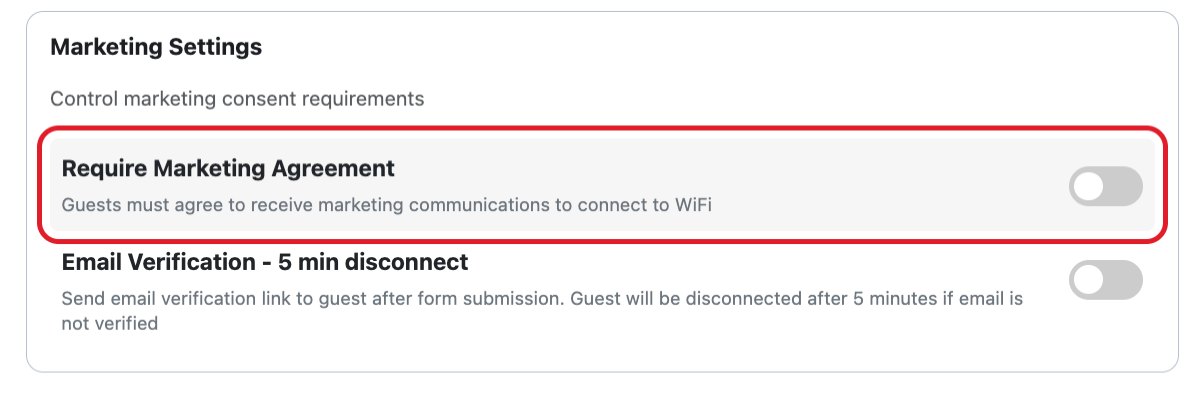
Switch off Require Marketing Agreement for properties that take Airbnb bookings. The marketing box stays; guests just don't have to tick it.
Comparing WiFi portal tools? See our round-up of vacation rental WiFi marketing tools, how BetterSTR compares as a StayFi alternative, or the WiFi QR code option if you don't have access points.
These are written replies from Airbnb Support dated 1 and 2 November 2026 (New Zealand time), quoted exactly; our questions are shortened. They are Support's answers to our specific setups, not a published change to Airbnb's policy, and Airbnb decides how its policies apply to any listing. We've asked for the thread to be reviewed by Airbnb's policy team and will update this post if anything changes. This isn't legal advice.
Common questions
Does Airbnb allow WiFi captive portals under the new house rules?
Yes. Airbnb Support confirmed in writing that requiring guests to accept terms of service on a standard captive portal is not an unreasonable additional agreement, provided the internet is free and available straight after sign-in.
Can a WiFi portal require a guest's name and email on Airbnb bookings?
Yes, when it is for network security, local cyber regulations or legal tracking such as copyright or ISP notices. Airbnb Support confirmed this against its Limiting host-imposed contracts and other requirements policy.
Can I require guests to join my mailing list to use the WiFi?
No. Airbnb says any marketing sign-up must be entirely optional and separate, and guests must be able to use the advertised WiFi without subscribing.
Can I offer free WiFi with a paid speed upgrade on Airbnb?
Yes, if the free baseline speed keeps working and the upgrade and its price are disclosed in the listing before booking.
Can I require ID verification for Airbnb guests paying a deposit?
No, unless the law or a documented building rule requires it. Airbnb says you can view ID in person at check-in if disclosed in the listing, but not copy or store it.